
Iron and manganese are rarely the most dangerous things in a water supply, but they generate the most complaints. Orange stains, black water at the tap, fouled filters, and iron bacteria in the distribution system all end up as calls to the owner, and eventually to the engineer who designed the plant.
The treatment concept is simple: oxidize the dissolved metals into particles, then filter them out. The design is where projects succeed or fail. Oxidant choice, dose, contact time, pH, and the filter that follows all have to work together, and manganese in particular leaves very little margin for error.
This guide is for consulting engineers evaluating ozone for iron and manganese removal. It covers the chemistry, how ozone compares to other oxidants, the design points that matter most, and where a packaged Guardian Ozone system fits in the treatment train.
The chemistry engineers need to get right
Treatment targets. EPA’s secondary standards are 0.3 mg/L for iron and 0.05 mg/L for manganese. These are aesthetic limits, driven by staining, color, and taste. Manganese also has a non-enforceable lifetime health advisory of 0.3 mg/L, set by EPA in 2004, which has made manganese removal a higher priority for many utilities.
Stoichiometric ozone demand. In theory, ozone oxidizes ferrous iron (Fe2+) to ferric iron (Fe3+) at 0.43 mg O3 per mg Fe, and manganous manganese (Mn2+) to manganese dioxide (MnO2) at 0.88 mg O3 per mg Mn. For a well with 1.5 mg/L iron and 0.30 mg/L manganese, the starting point is about 0.65 + 0.26 = 0.91 mg/L of ozone, before any other demand in the water.
Other demand counts. Sulfide, natural organic matter, and other reduced compounds also consume ozone. The real dose is set by demand testing on the actual water, not by the metals alone.
Iron is forgiving. Manganese is not. Extra ozone does little harm to iron oxidation. With manganese, excess ozone or excess contact time pushes the metal past MnO2 to soluble permanganate (Mn⁷⁺), which passes through filters and shows up as pink water. If oxidizable organics and enough contact time are present, permanganate can be reduced back to MnO2, but a design should not rely on that by accident.
pH and kinetics. Ozone oxidation of manganese works best around pH 8. Iron oxidizes quickly; manganese is much slower, so contact time has to be set for the manganese reaction.
Startup. If ozone replaces another oxidant, it can strip existing iron and manganese deposits from piping and equipment, so effluent metals may run high during a break-in period. Warn the owner before commissioning.
Ozone vs. other oxidants
Every common oxidant can remove iron. Manganese is what separates them.
| Oxidant | Dose per mg Fe / Mn | Manganese performance | Watch for |
|---|---|---|---|
| Aeration | Not dose-based | Cannot oxidize manganese | Limited to iron; organics-complexed iron resists it |
| Chlorine | Higher than ozone | Slow; often needs higher pH or a catalytic filter media | THM formation when organics are present |
| Potassium permanganate | 0.94 / 1.92 mg | Effective across a wide pH range | Overdose turns water pink; chemical handling and feed |
| Ozone | 0.43 / 0.88 mg | Fast and effective, best near pH 8 | Overdose forms permanganate; dose must be controlled |
| Sequestration (polyphosphate, silicate) | Not an oxidant | Holds metals in solution, does not remove them | Fails above roughly 1 mg/L iron or 0.1 mg/L manganese |
Ozone’s case goes beyond the metals. It is generated on site, so there is no oxidant to buy, store, or handle. It acts as a micro-flocculant that can improve filtration, and the same system can address taste, odor, color, and iron bacteria. The trade-off is that ozone dose has to be actively controlled, which is a design and controls question, not a reason to avoid it.
Designing the treatment train
An ozone iron and manganese system has four process steps and one control loop. The step that most often decides success is contact time, because it has to suit manganese, not iron.
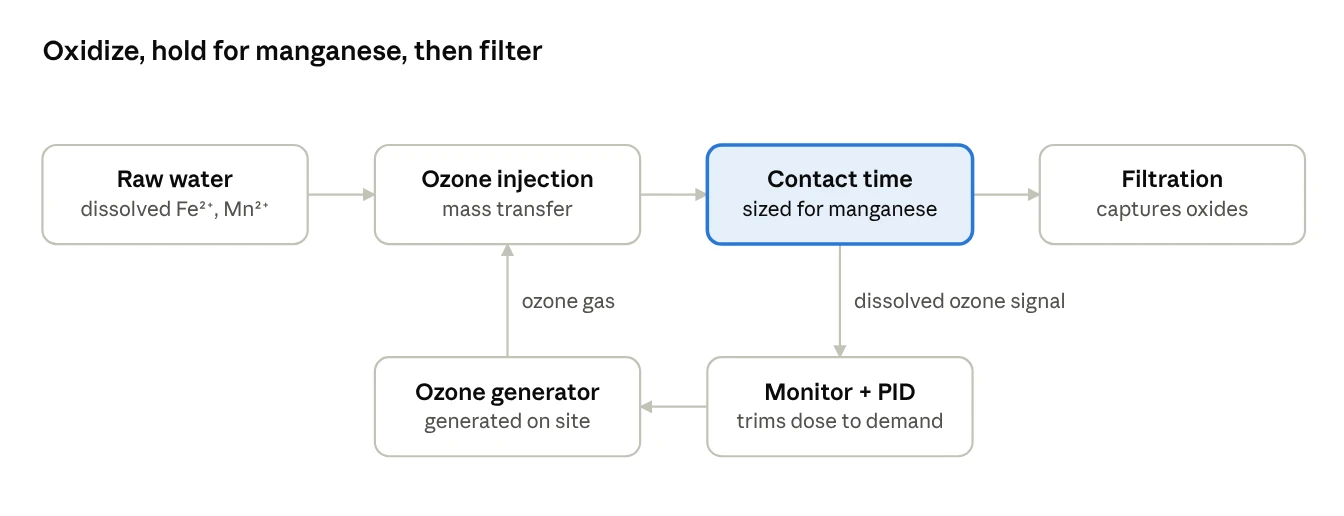
Ozone Iron and Manganese Train · 4 Process Steps, Closed-Loop Dose Control
The points that deserve the most attention in design:
- Base the dose on demand testing. Use stoichiometry as the floor, then confirm with bench or pilot testing on the actual water, under worst-case conditions. Seasonal swings in well water quality are common.
- Control dose to demand. Because excess ozone forms permanganate, the generator should track the water’s demand rather than run at a fixed output. Closed-loop control on a dissolved ozone or similar signal is the practical way to hold that window.
- Size contact for manganese. Iron is done long before manganese, so the contact volume is set by the manganese reaction at the design pH and temperature.
- Check pH. Manganese oxidation works best near pH 8. Low-pH groundwater may need adjustment upstream.
- Choose the filter for the solids. Backwashable media filtration after contact captures the iron and manganese oxides. Size it for the solids loading, and plan for the backwash waste stream.
- Handle off-gas. Undissolved ozone leaving the contactor needs to be destroyed before venting, and the equipment room needs ambient ozone monitoring.
- Plan for startup. Expect elevated metals during break-in if the plant previously used another oxidant, and set the owner’s expectations early.
Where Guardian Ozone fits
Guardian recommends the ATS Series for iron and manganese work. It is built for controlled aqueous ozone transfer ahead of separation, which is exactly the oxidation step in the train above.
For the design engineer, that means:
- The oxidation step arrives as one package. Generation, oxygen supply, mass transfer, contact, monitoring, and controls are designed to work together, so you specify one skid instead of integrating separate components.
- Dose control is built in. Ozone output is controlled around treatment demand through closed-loop control, which is what keeps manganese oxidation inside the window between under-dosing and permanganate.
- It drops into new or existing plants. The system can be added to an existing train ahead of current filters, or designed into a new plant, based on site requirements.
- Sizing starts with your water. Guardian evaluates water chemistry, metal concentrations, flow, and the downstream process before sizing a system.
- Redundancy is available. Where the source cannot go off line, a dual-generator 2X configuration keeps oxidation running during generator service.
Start with the water data
If you have a well or source with iron and manganese problems, send us the water quality data: iron, manganese, pH, alkalinity, sulfide, TOC, temperature, and design flow. Guardian Ozone’s application engineers will review the chemistry, estimate ozone demand, and recommend a system and treatment train your team can carry into design.
Talk to an Ozone Specialist · (407) 977-7250
Sources
- Guardian Ozone: Iron & Manganese Removal
- Guardian Ozone ATS Series
- Spartan Water Treatment: Iron and Manganese Removal Using Ozone
- Water Conditioning & Purification: Ozone Treatment of Iron, Manganese and Sulfide Ion
- Iron & Manganese Removal oxidant stoichiometry, Open Exam Prep
- California Water Boards: Manganese SMCL and EPA health advisory
- Iowa DNR: Manganese in Drinking Water