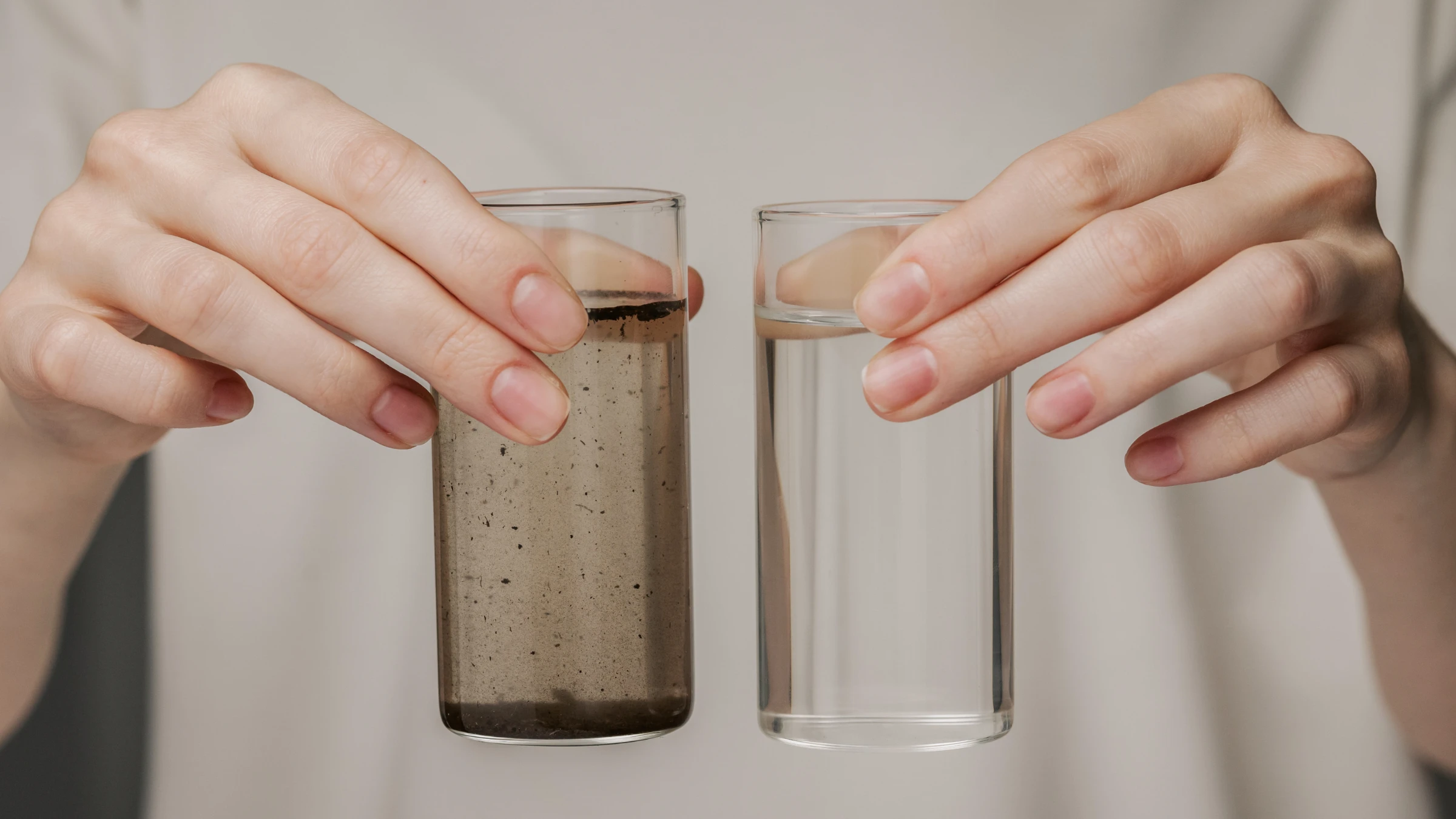

Customers forgive a lot from their water utility, but not water that smells like dirt. Taste and odor episodes drive customer complaints and erode trust in water that is otherwise fully compliant.
The hard part for the design engineer is scale. The compounds behind most complaints are detectable at a few nanograms per liter, they arrive seasonally and unpredictably, and conventional coagulation, sedimentation, and filtration do little to remove them. A plant can meet every regulation and still fail its customers’ noses.
This guide is for consulting engineers evaluating ozone for taste and odor control. It covers the compounds that cause most problems, how ozone compares to carbon and other oxidants, the design decisions that determine performance, and where a packaged Guardian Ozone system fits.
The compounds behind the complaints
Taste and odor problems come from two broad groups, and they behave very differently in treatment.
Inorganic sources. Hydrogen sulfide (rotten egg), iron, and manganese are common in groundwater. They oxidize readily, and ozone handles them easily.
Organic, biologically produced compounds. These cause most surface water episodes. The two that matter most are geosmin (earthy) and 2-methylisoborneol, or MIB (musty). Cyanobacteria and actinomycetes produce them in reservoirs and rivers, typically in warm months. Their odor thresholds are in the single-digit nanograms per liter: roughly 4 to 10 ng/L for geosmin and 15 to 29 ng/L for MIB in published ranges, and many people notice them near 10 ng/L. During a bloom, raw water can carry hundreds of ng/L.
Why conventional treatment falls short. Geosmin and MIB are small, stable molecules that conventional coagulation and filtration do not remove. Common oxidants struggle too: permanganate, chlorine, and chloramines do little against them, and chlorination can create its own chlorinous and medicinal odors.
Other compounds. Algal by-products such as β-cyclocitral and nonadienal (cucumber), and industrial or treatment-related compounds like trichloroanisole, also cause complaints. Many react quickly with ozone; a few do not.
How ozone compares
The key to understanding ozone for taste and odor is that it works through two pathways. Molecular ozone reacts quickly with many odor compounds, including β-cyclocitral, nonadienal, and β-ionone. Geosmin and MIB, however, react with molecular ozone very slowly. They are destroyed mainly by hydroxyl radicals, which form as ozone decomposes in water and react with them billions of times faster. Research from Eawag/EPFL found ozonation can oxidize most taste and odor compounds by more than 50% under typical drinking water conditions, and recommended advanced oxidation for the most ozone-resistant ones.
That is why ozone is usually designed as part of a strategy, not a single dose:
| Approach | Strengths | Limitations |
|---|---|---|
| Powdered activated carbon (PAC) | Low capital; fast to deploy for short episodes | Ongoing chemical cost; adds sludge; performance drops with natural organic competition |
| Granular activated carbon (GAC) | Effective long-term adsorption | Media exhaustion and replacement or reactivation cost |
| Permanganate, chlorine | Already on site at many plants | Weak against geosmin and MIB |
| Ozone alone | Destroys rather than transfers compounds; also disinfects and oxidizes iron, manganese, sulfide | Geosmin and MIB need adequate dose and radical formation; bromate risk in bromide waters |
| Ozone + hydrogen peroxide | Boosts hydroxyl radicals; lower ozone dose for geosmin and MIB | Adds peroxide feed and residual management |
| Ozone + biofiltration | Ozone makes residual compounds biodegradable; filters finish the job | Requires biologically active filters and time to establish |
The field results back this up. In a pilot for one regional water system facing MIB at 300 to 700 ng/L, ozone at 4 mg/L brought 400 ng/L MIB down to 4 ng/L, below the human detection threshold. Studies of ozone followed by biofiltration have reported 90 to 100% removal of geosmin and MIB, and ozone with biological activated carbon has kept treated water below odor thresholds even with MIB above 300 ng/L in the reservoir.
Design considerations
A successful taste and odor design pairs ozone with the right downstream step and sizes it for the worst week of the year, not the average one.
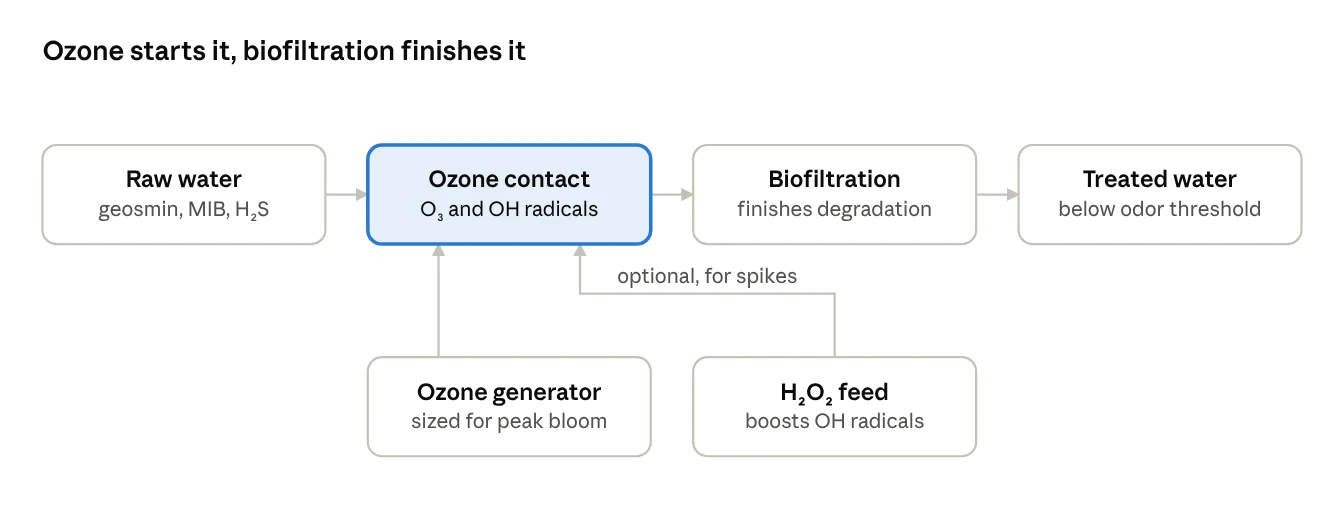
Ozone Taste and Odor Train · Ozone Contact, Optional Peroxide, Biofiltration
- Characterize the problem over a full season. Monitor geosmin and MIB through at least one bloom cycle. Peak concentration, duration, and frequency drive generator sizing and whether peroxide is needed.
- Size for the peak, control for the rest. Design capacity follows the bloom, but most of the year the plant needs far less. Specify turndown and closed-loop control so the system is not over-dosing in winter.
- Account for water chemistry. Alkalinity and carbonate scavenge hydroxyl radicals, so high-alkalinity water needs more ozone or peroxide to reach the same geosmin and MIB removal. pH and temperature also shift ozone decomposition and radical formation. Run bench or pilot testing on the actual source water.
- Consider staging. Ozone alone in the first chamber of a contactor can earn disinfection credit, with peroxide added in later chambers to drive radical oxidation of geosmin and MIB, meeting two objectives in one unit.
- Follow ozone with biofiltration. Ozone converts organic matter into more biodegradable forms. Biologically active filters remove that material and finish degrading partially oxidized odor compounds, which also helps limit regrowth in distribution.
- Check bromate. In waters with bromide, ozone and especially high-pH or radical-promoting conditions can form bromate, which has a 10 µg/L MCL. Include bromide in the water quality testing.
- Handle off-gas and safety. Destroy undissolved ozone before venting and provide ambient ozone monitoring in the equipment space.
Where Guardian Ozone fits
Guardian’s taste and odor control application targets earthy, musty, sulfurous, and process-related compounds. For most potable water projects, the ATS Series is the starting point.
- Packaged oxidation ahead of filtration. Generation, oxygen supply, mass transfer, contact, monitoring, and closed-loop control arrive as one system, so you specify one skid ahead of existing or new filters.
- Built for seasonal swings. Ozone output is controlled to treatment demand, which suits a problem that peaks for weeks and fades for months.
- Retrofit friendly. The system can be added ahead of existing filters, making a conversion to biologically active filtration a practical upgrade path.
- One step, several benefits. The same ozone that targets taste and odor also oxidizes iron, manganese, and sulfide and supports disinfection. See Guardian’s drinking water treatment
- No adsorbent to replace. Ozone destroys odor compounds rather than capturing them, so there is no carbon to buy, haul, or reactivate for the oxidation step.
Get ahead of the next bloom
The best time to design for taste and odor is before the next episode. Send us your seasonal geosmin and MIB data, along with alkalinity, pH, bromide, TOC, temperature range, and design flow. Guardian Ozone’s application engineers will review the chemistry, estimate ozone demand at peak and off-season, and help you fit ozone into the treatment train.
Talk to an Ozone Specialist · (407) 977-7250
Sources
- Peter and von Gunten, Oxidation kinetics of selected taste and odor compounds during ozonation (EPFL)
- Cerón-Vivas et al., Geosmin and 2-MIB removal in drinking water treatment (IWA)
- Oxidation of geosmin and MIB using O₃/H₂O₂: kinetic evaluation
- Assessing and reducing taste and odor issues in drinking water
- Liu et al., MIB and geosmin emergency response, ozone-BAC (EPA HERO)
- Nerenberg, Rittmann and Soucie, Ozone/Biofiltration for Removing MIB and Geosmin, Journal AWWA 92:12 (2000)
- Guardian Ozone ATS Series