

Arsenic is not an aesthetic problem. EPA’s arsenic rule, issued in 2001, set an enforceable maximum contaminant level of 10 µg/L, and naturally occurring arsenic puts many groundwater sources over it. When a well tests over the limit, the owner calls the engineer, and the design has to work the first time.
Most arsenic removal technologies share one weakness: they remove arsenate, As(V), well, and arsenite, As(III), poorly. Groundwater is usually full of arsenite. That makes the oxidation step ahead of removal one of the most important decisions in the design, and one of the most often under-designed.
This guide is for consulting engineers working on arsenic treatment. It explains why oxidation comes first, how ozone compares with other oxidants, how pre-oxidation fits into common treatment trains, and where a packaged Guardian Ozone system can help.
Why oxidation comes first
Arsenic in drinking water sources is almost always inorganic, in one of two forms:
- Arsenite, As(III). Dominant in anoxic groundwater. Below about pH 8.5 it exists mainly as uncharged H3AsO3, so adsorptive media, ion exchange, and coagulation have little to grab onto.
- Arsenate, As(V). Dominant in oxygenated surface water. It is negatively charged at normal pH and is removed far more effectively by most technologies.
That is why regulators and design guides treat pre-oxidation as essential. EPA’s research group lists oxidizing As(III) to As(V) as a step to take before applying treatment, and Health Canada’s technical guideline calls pretreatment critical to removal performance with any downstream technology.
Speciation is a design input. Sample for As(III) and As(V) separately, with field preservation, because arsenite can convert to arsenate during sampling and storage. A total-arsenic result alone can hide how much oxidation the plant needs.
Ozone demand. Converting As(III) to As(V) is a two-electron oxidation, so the theoretical ozone demand is about 0.64 mg O3 per mg As(III). At typical arsenic concentrations that is a tiny dose. In practice the dose is set by everything else in the water that consumes ozone first, especially iron, manganese, sulfide, and organic matter.
Choosing the oxidant
A bench study of As(III) oxidants, published in Water & Wastes Digest, found that chlorine, permanganate, ozone, and manganese-oxide media all worked, while chlorine dioxide, monochloramine, and UV alone showed little or no effect. The practical differences are speed, by-products, and what the oxidant does to the rest of the plant.
| Oxidant | As(III) oxidation | Design considerations |
|---|---|---|
| Air or oxygen | Very slow; days, not minutes | Not practical as the only oxidant |
| Free chlorine | Fast and complete | Can form chlorinated disinfection by-products with organics; chemical storage and feed |
| Potassium permanganate | Fast, about one minute | Adds solids to the filter; overdose turns water pink |
| Chlorine dioxide, monochloramine | Poor or very slow | Not recommended for As(III) |
| Ozone | Extremely fast; complete in under 15 seconds in the study | Generated on site; no chlorinated by-products; dose must be controlled; bromide waters need a bromate check |
Ozone’s case is strongest where the plant has more than one problem. The same oxidation step that converts arsenite also oxidizes the iron and manganese that often travel with it, controls sulfide and taste and odor, and avoids adding a chlorinated by-product risk ahead of the removal process. For a utility that wants to keep chlorine as its final disinfectant only, ozone separates the two jobs cleanly.
Designing the treatment train
Ozone does not remove arsenic by itself. It converts arsenite into a form the removal process can capture. The removal step is chosen by water quality, flow, and residuals handling.
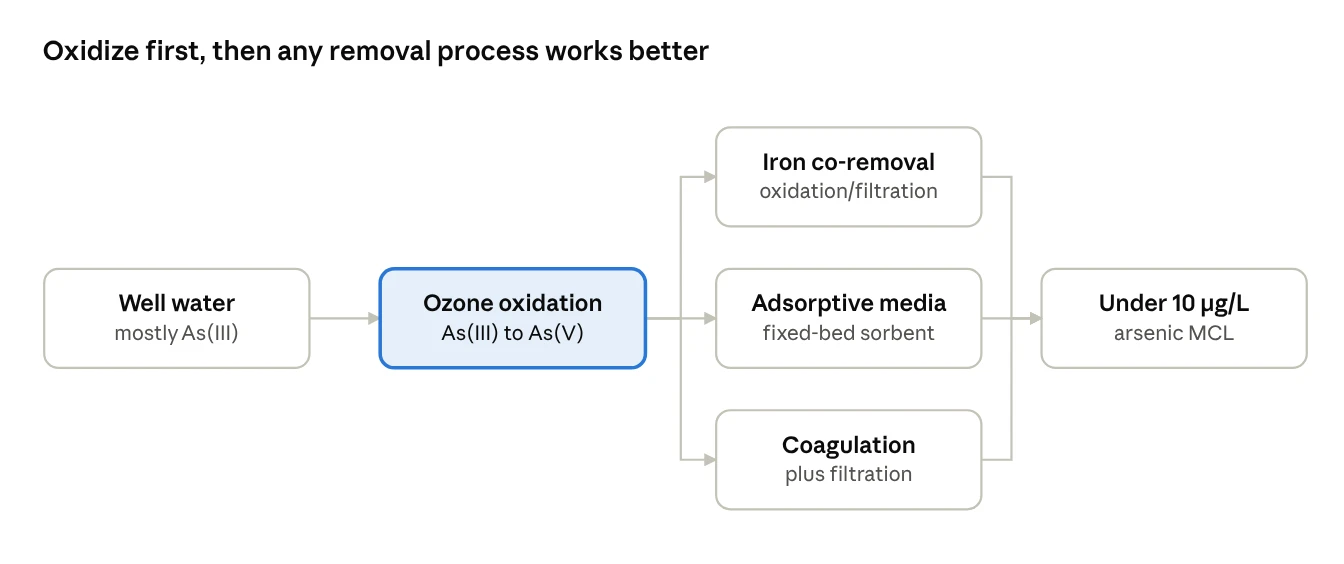
Arsenic Treatment Train · Ozone Pre-Oxidation Ahead of Three Removal Options
Iron co-removal (oxidation/filtration). Where the water already carries iron, ozone oxidizes both, and arsenate adsorbs onto the iron oxide solids captured by the filter. EPA’s guidance for this best available technology pairs about 80% arsenic removal with an iron-to-arsenic ratio of roughly 20:1, so check whether the native iron is enough or a ferric salt is needed. For many groundwater plants this is a cost-effective route, and it is a natural fit with an existing iron and manganese filter.
Adsorptive media. Media systems remove As(V) far better than As(III), so pre-oxidation directly extends bed life and lowers media replacement cost. Confirm with the media supplier that the oxidant residual reaching the bed is compatible.
Coagulation and filtration. Ozone ahead of coagulation converts arsenite so it can be removed with the floc, and its micro-flocculation effect can help filter performance.
Across all three trains, the design points that matter most:
- Dose to total demand. Iron, manganese, sulfide, and organics consume ozone before arsenic does. Set the dose by demand testing, not arsenic stoichiometry.
- Verify oxidation, not just dose. Speciate arsenic after the oxidation step during pilot and startup to prove As(III) is gone.
- Check bromide. Ozone can form bromate in bromide-bearing water, which has its own 10 µg/L MCL.
- Watch manganese. If manganese is present, avoid excess ozone that would form permanganate.
- Pilot first. State guidance, such as the Ohio EPA arsenic design manual, sets piloting and design criteria for oxidation, adsorptive media, and anion exchange systems. Check your state’s requirements early.
Where Guardian Ozone fits
The ATS Series is built for controlled aqueous ozone transfer ahead of a separation step, which is the role pre-oxidation plays in every arsenic train above.
- One packaged oxidation step. Generation, oxygen supply, mass transfer, contact, monitoring, and closed-loop control come as one system, so you specify a skid rather than integrating components ahead of your removal process.
- Controlled dose. Output is controlled to treatment demand, which matters when the same water carries manganese or bromide and over-dosing has consequences.
- One step, several problems. Where arsenic arrives with iron, manganese, sulfide, or taste and odor, the same ATS system can address them together. See Guardian’s iron and manganese removal and drinking water treatment
- Retrofit friendly. The system can be added ahead of existing filters or media vessels, which suits plants upgrading for arsenic compliance.
- No oxidant chemicals on site. Ozone is generated from oxygen at the plant, so there is no chlorine or permanganate to store and feed for the oxidation step.
Bring us your arsenic data
If you are designing for an arsenic exceedance, send us the water quality data: total arsenic and As(III)/As(V) speciation, iron, manganese, pH, sulfide, TOC, bromide, and design flow. Guardian Ozone’s application engineers will review the chemistry, estimate ozone demand, and help you fit pre-oxidation into the removal process you have chosen.
Talk to an Ozone Specialist · (407) 977-7250
Sources
- Health Canada: Guideline Technical Document, Arsenic
- S. EPA ORD: Arsenic Treatment Options (Sorg and Lytle)
- Water & Wastes Digest: Oxidizing Arsenic III to Arsenic V for Better Removal
- Water Quality Association: Arsenic Fact Sheet
- Ohio EPA: Arsenic Removal Design Manual
- Technologies for Arsenic Removal from Water, IJERPH
- Guardian Ozone ATS Series